

Image Credit: cryptofest
- Coin Insider's editor in chief attended Crypto Fest Cape Town on Nov. 20, where stablecoins, tokenization and AI agents dominated, with security throughout.
- Speakers warned that AI speeds up attacks and that victims struggle to get banks, exchanges and investigators to coordinate recovery.
- Panels stressed stablecoins must be spendable on arrival, tax rules on wrapped tokens need clarity, and AI agents need strict control limits.
We sent our editor in chief to Crypto Fest Cape Town on Nov. 20, 2026, for a day of talks, panels and conversations with people working across the industry. Here are our takeaways.
Stablecoins, tokenized assets and AI agents were among the main topics, with security running through the discussions. As speakers explored new ways to move money and automate decisions, questions about fraud, control, and responsibility kept coming up.
One question stayed with us: are the safeguards keeping pace with the financial authority we want to give these systems?
Security Needs Faster Detection and a Clear Path to Recovery
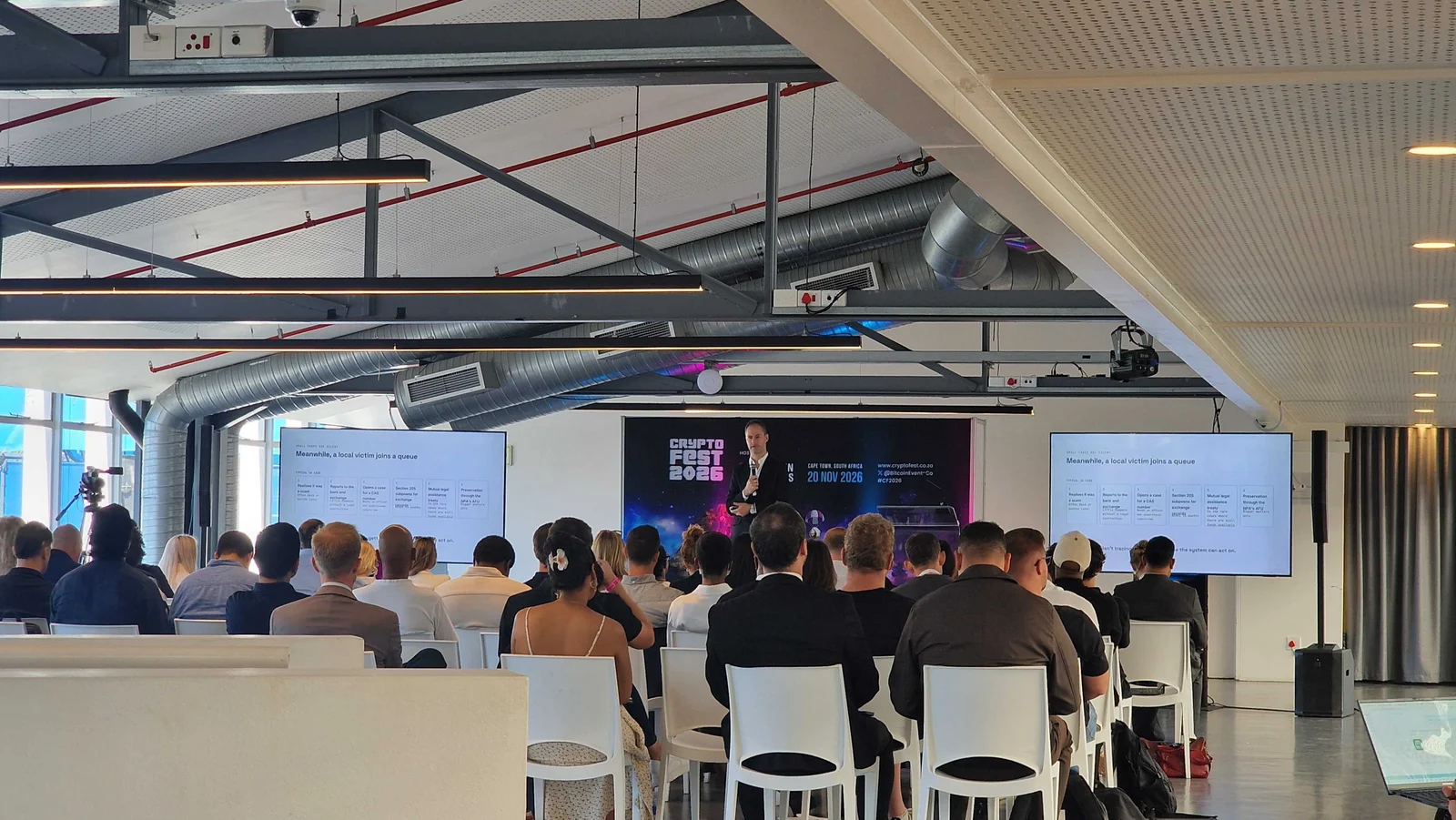
Molly Holmes, head of Africa at crypto security company Blockaid, was among the people we met at Crypto Fest 2026. She warned that AI is being used to reduce the preparation behind an attack from months to mere minutes, giving scammers a much faster route to their targets.
The Oct. 29 Binance hack showed how attackers can misuse trusted systems. Compromised employee devices gave them a route into wallet infrastructure, while malicious transfers took place alongside legitimate withdrawals.
On the privacy panel, Smile ID’s Dustin Strydom addressed the manipulation of identity documents and facial images for impersonation. Information collected to verify a customer can become useful to a criminal if it falls into the wrong hands.
That discussion also raised the prospect of AI mimicking an account holder’s usual spending or trading behavior. An attacker who can imitate those patterns gives security systems fewer obvious signs that control of the account has changed.
The privacy panel examined whether decentralized systems could reduce reliance on central stores of personal information. Yet greater individual control brings responsibility for protecting and recovering access. Luke Naude-Lorentz argued that Web3 was only part of the answer, with regulation also having a role.
For victims, meanwhile, the most pressing challenge is getting help. Chris du Toit, founder of CRYME Blockchain Forensics, highlighted the frustration of being passed between banks, exchanges and investigators, even when stolen funds can be followed publicly.
He also raised barriers to sharing sensitive information between institutions. Investigators may be able to trace a payment, but getting the organizations involved to coordinate a response remains an issue.
The response to the Nov. 2 Mercado Bitcoin incident offers a recent example of that coordination. Chainalysis reported working with the exchange, law enforcement and industry partners to help freeze nearly $10 million. Finding the funds, getting them frozen and returning them to a victim each require action beyond following a transaction trail.
Stablecoins Need to Work All the Way to the Recipient
Trevor Goott of Yellow Card approached stablecoins through corporate cross-border settlements and the demand for dollars in African markets. He pointed to USDT and USDC as familiar options for dollar-linked transfers.
Christo de Wit, Luno’s South Africa country manager, put usefulness at the center of adoption:
“If you create utility and demand, adoption will follow.”
The debate over local-currency stablecoins followed from that question of demand. De Wit challenged the strength of their liquidity and practical use. A token tracking a familiar currency still needs people willing to hold it and markets where it can be exchanged.
For a business sending money overseas, those markets matter at both ends of the payment. Being able to send a token quickly is only useful if the recipient can turn it into money they can actually spend.
Jurgen Kuhnel, co-founder and CEO of Xago, focused on that last step in his session on settlement and finality. A blockchain transfer can be complete while the recipient still faces conversion, limited local liquidity or bank processing.
Someone paying a supplier or sending money to family goes through the whole process. They need to know what arrives, what it costs and when it becomes available.
Goott’s vision was for stablecoins to become the invisible part of a payment, allowing finality to be as immediate as settlement. Users would choose the payment service without necessarily making a conscious choice about the stablecoin doing the work underneath.
Tax Questions Exposed a Need for Clearer Guidance
The morning tax and regulation panel raised a question that applies to tokens and their wrapped versions generally, with Bitcoin used as one example. Wrapping can let someone use a representation of an asset in a different application or network, while keeping an investment linked to the original asset.
For the user, that can feel like changing how they use a holding. The tax question is whether wrapping or unwrapping is treated as a separate taxable transaction, even when they have not sold into traditional money.
The discussion also considered whether more consistent treatment across the global market would make crypto easier to use. Products can be designed to work across networks and borders, but users still need guidance on the consequences in the jurisdictions that apply to them.
That uncertainty is what discourages numerous people from adopting crypto as a standard payment option even though the technology makes the transaction itself straightforward.
Tokenization Brings Investment Funds On-Chain
Another focus at Crypto Fest was how tokenized assets could fit into investment portfolios. The closing capital-markets panel brought together Adam Duxbury of Ninety One, Robert Cousins of Absa, Dishen Govender of Bitpanda Enterprise and blockchain developer Carel de Jager, with Callan Richardson moderating.
We also met Govender, Bitpanda Enterprise’s head of Africa. His company helps banks and fintechs build digital-asset services, giving it a role in the infrastructure through which tokenized investments could reach more customers.
Tokenization represents an investment through a blockchain token, making it possible to hold and transfer it through digital wallets. Financial firms see opportunities to automate administration and connect eligible fund holdings or stock-linked products with trading and other services.
Outside the conference, BlackRock’s BUIDL is an example of that approach. Launched in 2024 for qualified investors, it holds cash, U.S. Treasury bills and repurchase agreements, with tokens transferable between approved investors around the clock.
AI Readiness Starts With Costs and Control
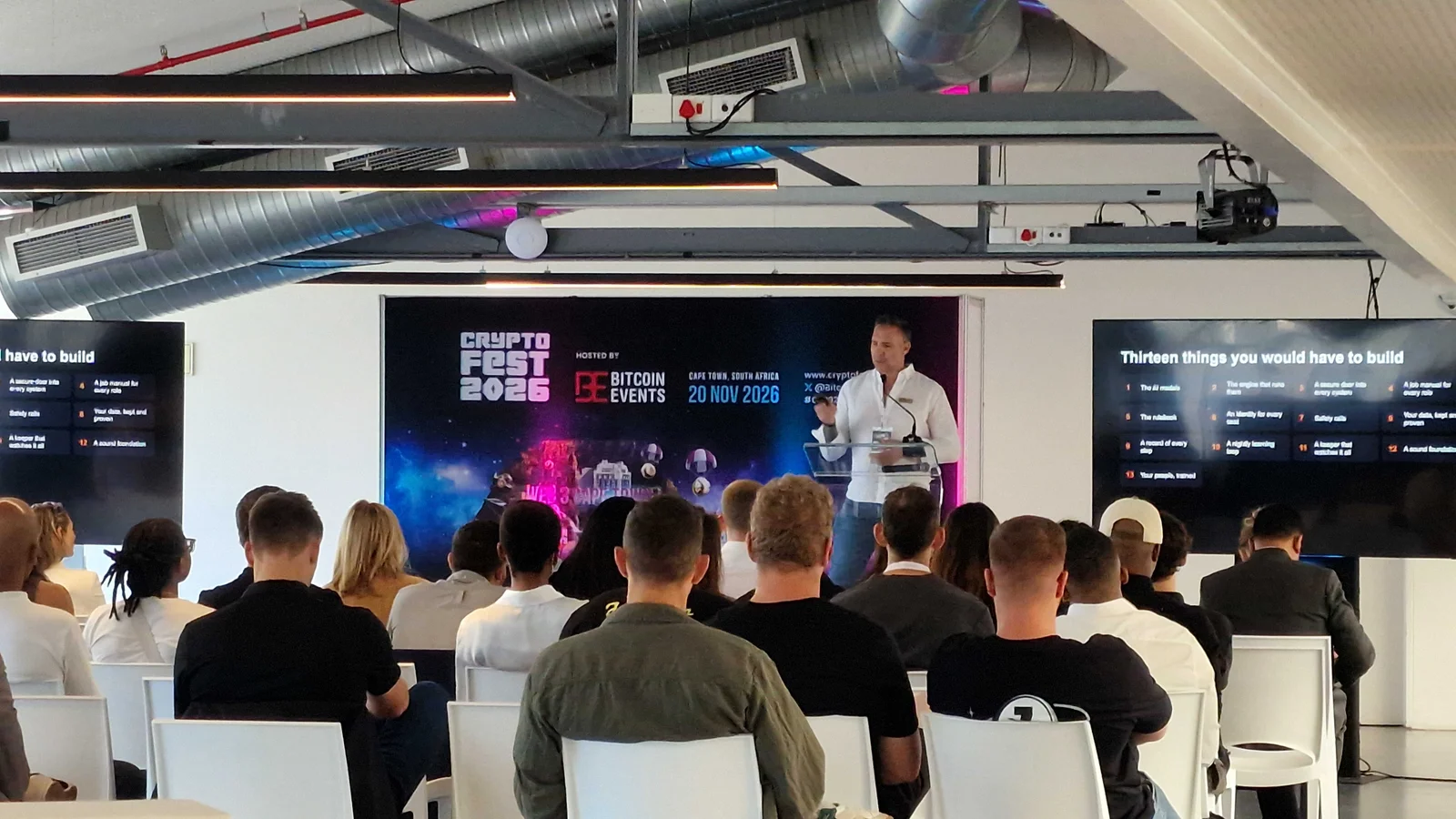
In his talk on business readiness for AI, Garry Cahay, group CEO of Ello Technology, challenged how quickly companies are putting tools to work without checking them properly. His concern was that the push to adopt can run ahead of testing whether a tool does the job, makes financial sense and is safe to connect to company systems.
He asked businesses to imagine doing ten times their current workload, then consider whether that extra activity would generate profit or simply expand expenses.
Cahay also pressed businesses on how much control they retain over company information and systems. Assessing an AI tool means understanding what data it receives, who can access that information and how the access could be misused.
A business that cannot answer those questions has more preparation to do before giving the tool greater responsibility. His warning was blunt:
“AI is not scary. Not being prepared is.”
Are We Ready to Let AI Agents Trade With Real Money?
Carel de Jager’s session took up the prospect of agents trading, paying and investing on our behalf, making the question of control particularly urgent.
An agent’s permission to place a trade should involve a separate decision about withdrawals. An agent might need access to particular markets and a limited balance, while its owner keeps control over where and how money can leave the account.
The financial-crime panel also examined responsibility when agents act, with speakers including du Toit and Binance compliance executive Samukele Mkhize.
Their discussion raised a practical question for anyone relying on automated financial decisions: if an agent follows a malicious instruction or sends money to the wrong recipient, who can step in, and who is actually responsible?
AI also has a role to play in protecting funds. Blockaid, for example, says it combines machine-learning checks with agents that investigate suspicious activity, helping security teams review transactions at a scale that would otherwise be difficult to manage manually.
The question we left Crypto Fest 2026 with is this: how much financial freedom should these agents get, who is responsible for misuse, and what needs to happen before we’re ready to use them more widely?