How to Buy Ethereum: A Beginner’s Guide

Key Takeaways
- Multiple paths to buy ETH: Centralized exchanges (Coinbase, Kraken, Binance.US, Gemini) offer the most features and lowest fees, ETFs suit retirement accounts and hands-off investors, and payment apps/wallets like MetaMask offer easy but pricier on-ramps.
- How you fund and store ETH matters: ACH transfers are cheapest, credit cards are the most expensive (avoid due to cash advance fees), and for any serious holdings, moving ETH off the exchange into a self-custody wallet (hot or cold) is safer than leaving it in exchange custody.
- Nearly every ETH action is a taxable event: Except buying and holding. Selling, swapping, spending, and earning staking rewards all trigger gains/income, and starting in 2026 the IRS will get much more visibility via Form 1099-DA reporting.
Ethereum is the second-largest cryptocurrency by market capitalization and one of the most consequential pieces of financial infrastructure built in the past decade. Whether you are drawn to it as a long-term investment, as a gateway into decentralized finance, or because you want to interact with the thousands of applications built on its network, buying ETH in 2026 is more accessible than it has ever been.
This guide covers everything you need to know: what Ethereum actually is, how to choose where to buy it, which payment methods make sense for your situation, and how to execute your first purchase. We’ll also look at how to understand and minimize fees, as well as where and how to store your ETH securely. Read on.
What Ethereum Is and Why It Matters
Before putting money into any asset, you should understand what you are buying. Bitcoin was designed primarily as digital money, a way to send value between parties without relying on banks or governments. Ethereum is something different. It is a programmable blockchain: a global, decentralized computer that no single company or government controls, and on which code can execute automatically and autonomously.
Ethereum was proposed by developer Vitalik Buterin in late 2013, crowdfunded in 2014, and launched on July 30, 2015. The defining innovation was the smart contract, a self-executing program that runs on the blockchain without intermediaries. That one feature gave birth to entirely new industries, including:
- Decentralized finance (DeFi), which lets users borrow, lend, and earn interest without a bank
- Non-fungible tokens (NFTs), which allow verifiable digital ownership
- Decentralized autonomous organizations (DAOs), which allow communities to govern collectively on-chain
- A growing layer of enterprise applications that large institutions are building on top of Ethereum’s infrastructure.
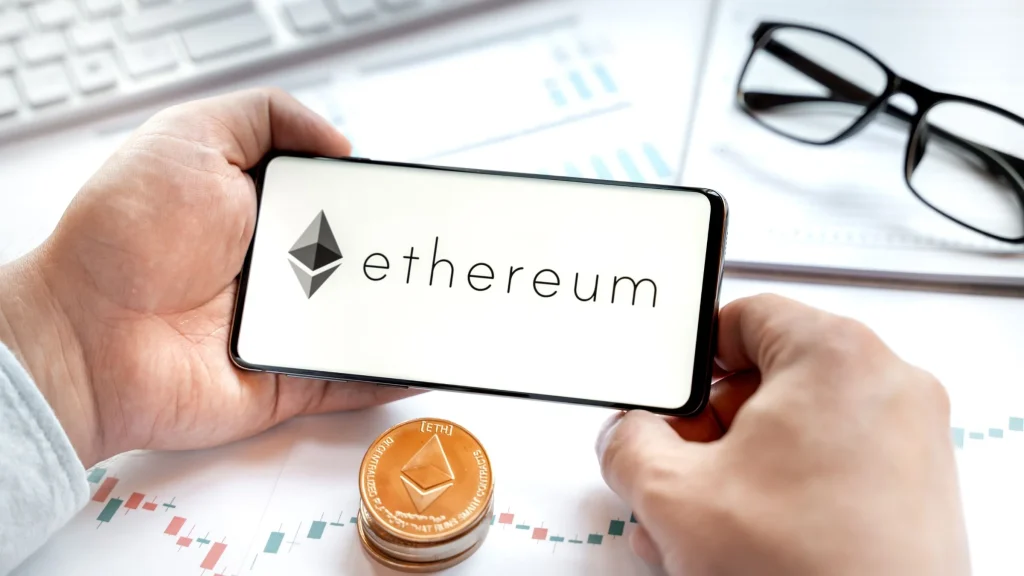
Ethereum’s native token is called Ether, and its ticker is ETH. ETH serves several roles simultaneously. It is the currency used to pay for computational work on the network, what Ethereum calls “gas fees.” It is the asset staked by validators who secure the network and earn rewards in return. And it is increasingly held as a store of value and a productive yield-generating asset.
How to Buy Ethereum: Step by Step
Learning how to buy Ethereum cryptocurrency is a simple process. It requires very little setup. You need to have the following ready before getting started:
- A smartphone or computer with an internet connection.
- A Government-Issued Photo ID: Most platforms will require you to verify your identity before you can deposit dollars or move funds. This is a legal requirement known as Know Your Customer (KYC) compliance, mandated in most countries to prevent fraud and money laundering.
- A Payment Method: Your options are a bank account, a debit card, or a credit card. Each carries different fees and settlement speeds, which are covered in detail below.
- A Decision About Custody: When you buy ETH, it has to live somewhere. It can stay on the platform where you bought it, or you can transfer it to a private wallet you control.
Both options are valid depending on your goals. If you are a long-term holder who wants maximum security, a personal wallet is the right call. If you are just getting started and plan to sell within a few months, leaving it on the exchange is fine while you learn. Make this decision before you buy. And with that, here are the steps to take to buy Ethereum.
Step 1: Choose Where to Buy Ethereum
In 2026, you have three main categories of buying options: centralized exchanges, exchange-traded funds (ETFs) available through traditional brokerages, and alternative entry points like payment apps and self-custody wallets with built-in purchase features. The good news is that platforms are more polished, regulatory guardrails are clearer, and the range of entry points means there is a path suited to virtually every type of investor.
Centralized Exchanges (CEX)
Centralized exchanges remain the most popular and feature-rich way to buy ETH. They are companies that operate order books, facilitate trades between buyers and sellers, hold your funds in custody, and provide interfaces for depositing fiat currency and withdrawing crypto. They are licensed, regulated, and required to verify your identity. The major U.S.-accessible options include Coinbase, Kraken, Binance.US, Gemini, and Bybit.
| Exchange | Fees | Key Notes | Best For |
|---|---|---|---|
| Coinbase | ~0.5%-1.5% on simple buys; lower maker/taker fees via Coinbase Advanced | Clean interface, strong regulatory standing, easy recurring buys | Beginners |
| Kraken | Free access to Kraken Pro (lower fees); basic tier slightly higher | Strong security track record; not available in NY or ME | Security-conscious users |
| Binance.US | Often ≤0.1% on advanced interface | Broad asset support; past regulatory scrutiny, verify availability in your state | Low-fee, active traders |
| Gemini | Lower fees via ActiveTrader vs. standard buy interface | NY-based, SOC 2 certified, strong compliance reputation | Institutional-grade compliance |
When evaluating any exchange, compare: trading fees (both for simple buys and for order-book trades), deposit fees, withdrawal fees to personal wallets, security practices (two-factor authentication, insurance coverage, cold storage ratios), customer support quality, and whether the platform is licensed to operate in your state.
Ethereum ETFs
For investors who want exposure to ETH’s price without the complexity of wallets, private keys, and on-chain mechanics, learning how to buy Ethereum ETFs is now a legitimate option. Spot ETFs were approved by the SEC in mid-2024, and as of 2026, multiple products from major issuers trade on U.S. exchanges.
Grayscale’s Ethereum Staking ETF (ETHE) and BlackRock’s iShares Staked Ethereum Trust ETF (ETHB) are among the most prominent, with several more from Fidelity, Franklin Templeton, Invesco, 21Shares, and VanEck in the pipeline or already available.
Pros:
- Ethereum ETFs can be bought through any standard brokerage account, including tax-advantaged accounts like Traditional and Roth IRAs, making them the most tax-efficient structure for some long-term investors.
- Staking-enabled ETFs pass staking rewards to shareholders as periodic distributions; gross staking rewards on Ethereum currently range from roughly 3.1% to 3.3% annually, translating to net distributions of approximately 1.9% to 2.6% after fees.
Cons:
- They carry an annual management fee (ETHE charges 2.5%; other products charge less).
- They do not allow you to use the Ethereum network directly, interact with DeFi applications, or hold ETH in a self-custody wallet.
Learning how to buy Ethereum ETFs is the right choice for investors who are comfortable in traditional financial markets, want a fully managed product, or specifically need retirement account compatibility. They are not the right choice for anyone who wants to use Ethereum as a network, for DeFi, NFTs, or dApps, rather than simply hold the token.
Payment Apps and Alternative Platforms
PayPal, Cash App, and Venmo all support Ethereum purchases with minimal friction. You can set up a recurring buy in minutes using an existing account. The tradeoffs are real, though: fees tend to be higher than on dedicated exchanges, withdrawal options to personal wallets may be limited or unavailable (PayPal has added withdrawal capability but with restrictions), and you typically do not receive a direct on-chain ETH balance.
Self-custody wallets like MetaMask have also added built-in purchase options. MetaMask aggregates quotes from multiple payment providers and lets you buy ETH directly into a wallet you control using a debit card, credit card, bank transfer, Apple Pay, Google Pay, or PayPal, with no exchange account required.
The minimum purchase varies by provider but can be as low as $1 to $5. This path suits users who want to skip exchange custody entirely and go straight into a self-custody environment, though on-ramp fees through wallet interfaces are sometimes higher than exchange fees.
Decentralized exchanges (DEXs) like Uniswap allow you to swap one crypto asset for another on-chain without a centralized intermediary. They are not a practical entry point for first-time buyers because they require you to already hold another cryptocurrency and a funded wallet before you can trade. If you are starting from dollars, begin with a centralized exchange.
Step 2: Create and Verify Your Account
Once you have chosen a platform, the account creation process is straightforward. You will provide your full name, email address, and a secure password. Enable two-factor authentication immediately. Use an authenticator app (Google Authenticator or Authy) rather than SMS, which is vulnerable to SIM-swapping attacks.
KYC verification follows account creation. Most platforms will walk you through a guided process: submit a photo of your government-issued ID, then take a selfie or complete a short liveness check to confirm you match the document. Basic verification unlocks standard deposit and withdrawal limits.
The verification process usually completes in minutes, though during high-traffic periods it can take up to 24 hours. Do not fund your account until verification is confirmed, as unverified accounts may have restricted withdrawal access.
Step 3: Fund Your Account
Most exchanges accept three payment types: bank transfers (ACH or wire), debit cards, and credit cards. Understanding the fee and timing differences between them will save you real money.
Bank transfers via ACH are the cheapest option. Many exchanges, including Coinbase, charge zero fees on ACH deposits. The downside is timing: ACH transfers typically settle in one to five business days, though some platforms allow you to begin buying immediately against the pending deposit. Wire transfers are faster (same or next business day for domestic wires) but usually carry a fee, both from the exchange and from your bank.
How to Buy ETH With Debit Card
Debit card purchases are instant and straightforward. Fees are higher than ACH, typically 1.5% to 2.5% on most major platforms, but you can buy and hold ETH immediately without waiting for a bank transfer to clear. If your priority is speed over cost, a debit card is the right tool.
How to Buy Ethereum With Credit Card
Credit card purchases, where supported. If you’re wondering how to buy Ethereum with credit card, you must understand that this is the most expensive entry point. In addition to the platform fee, your credit card issuer may categorize the transaction as a cash advance, triggering a cash advance fee (often 3% to 5%) and interest that begins accruing immediately rather than at the end of the billing cycle. Use a debit card instead unless you have a specific reason not to.
P2P (peer-to-peer) trading, available on platforms like Binance and Bybit, lets you buy stablecoins or crypto directly from other users using local payment methods, sometimes with no platform fee on the P2P side. It is an option worth exploring for large purchases, but requires more diligence: verify the counterparty’s reputation on the platform before transacting.
Step 4: Place Your First Order
With your account verified and funded, you are ready to buy. Navigate to the trading or buy section of your platform. You will search for ETH and see one or more trading pairs, ETH/USD if you deposited dollars, or ETH/USDT if you are going crypto-to-crypto.
You will need to choose an order type. Two types cover the vast majority of use cases:
A market order executes immediately at the current market price. You enter the dollar amount you want to spend or the number of ETH you want to receive, confirm the transaction, and it fills in seconds. Market orders are appropriate when you want to buy now without worrying about timing.
A limit order lets you specify the price at which you are willing to buy. If ETH is trading at $2,000 and you set a limit order at $1,900, your order sits open until the price drops to your target, or it expires if the price never reaches it. Limit orders are appropriate when you believe ETH is likely to pull back before you want to enter, or when you are transacting large amounts and want to avoid slippage.
For beginners, the simple buy interface, which places a market order on your behalf, is perfectly adequate.
- Review the fee breakdown before confirming: you should see the purchase amount, the exchange’s fee, and the total cost clearly displayed.
- Confirm the order. Your ETH will appear in your exchange wallet within seconds for a market order.
One practical note on strategy: rather than investing a lump sum all at once, many experienced investors use a technique called dollar-cost averaging (DCA), buying a fixed dollar amount at regular intervals (weekly or monthly) regardless of price. DCA removes the stress of trying to time the market, smooths out your average entry price over time, and helps prevent emotional decision-making during periods of volatility.
Understanding Gas Fees
Gas fees are one of Ethereum’s most important, and most misunderstood, mechanics. They are separate from what an exchange charges you when you buy ETH. Gas fees are what you pay to the Ethereum network when you execute on-chain transactions: sending ETH from one wallet to another, swapping tokens on a DEX, interacting with a smart contract, or any other action that requires computation on the blockchain.
Every action on Ethereum requires a certain amount of gas, a unit that measures computational effort. Gas prices, denominated in gwei (one gwei equals one-billionth of an ETH), fluctuate based on network demand. When the network is congested, such as during a heavily anticipated NFT mint, a sharp market move, or a period of high DeFi activity, everyone competes to have their transaction included in the next block by tipping validators more. Gas prices spike.
During calm periods, a simple ETH transfer might cost $1 to $3. During heavy congestion, fees can exceed $20 or more for a basic transaction.
To minimize gas costs: check the Ethereum Gas Tracker on Etherscan before transacting, which shows real-time gwei prices and estimates the cost of common transaction types. Transactions are typically cheapest during late night and early morning hours in U.S. time zones, and on weekends when network activity drops.
If you are buying ETH on an exchange and leaving it there, gas fees are not something you will encounter in daily use. You will only encounter them when you withdraw ETH to a personal wallet or transact on-chain.
How to Store Your ETH Securely
Where you keep your ETH matters enormously. The phrase in crypto that captures this best is: “not your keys, not your coins.” When you hold ETH on a centralized exchange, the exchange holds the private keys that control those funds. If the exchange is hacked, goes insolvent, or freezes withdrawals, you may lose access. This risk is real, as multiple major exchanges have failed in recent years.
For long-term holdings, or for any meaningful amount of ETH, transferring to a personal wallet is strongly recommended. Personal wallets come in two categories:
Hot Wallets
These are software-based wallets connected to the internet. MetaMask is the most widely used hot wallet for Ethereum. It is a browser extension and mobile app that stores your private keys locally on your device. Hot wallets are convenient for daily use and interacting with dApps, DeFi, and NFT platforms, but they carry more risk than hardware wallets because your keys are on an internet-connected device.
Cold wallets
These are hardware wallets, physical devices that store your private keys completely offline. Ledger and Trezor are the two dominant brands. To sign a transaction, you physically confirm it on the device. Even if your computer is fully compromised by malware, a cold wallet keeps your funds safe because the private key never leaves the device. Cold wallets are the gold standard for securing any ETH you do not need to access regularly.
When you set up any self-custody wallet, you will receive a seed phrase, usually 12 to 24 random words in a specific order. This seed phrase is the master key to your wallet. Write it down on paper (or engrave it on metal for fire resistance) and store it somewhere physically secure, offline, and private.
Never photograph it, type it into any website or app, or share it with anyone. If you lose your seed phrase and also lose your device, your ETH is gone permanently. There is no password reset, no customer support line, no recovery option.
Important Note:
When withdrawing ETH from an exchange to a personal wallet, triple-check the destination address before confirming. Blockchain transactions are irreversible. Always send a small test amount first, perhaps $5 to $10 worth of ETH, confirm it arrives in your wallet, and then send the remainder.
Also make sure you select the correct network. ETH sent on the wrong network (for example, the Binance Smart Chain instead of Ethereum mainnet) may be irretrievable without technical intervention. Read our guide on How to Cash out Cryptocurrency if you ever need to convert your ETH back to cash.
Tax Obligations for U.S. Investors
Ethereum, like all cryptocurrency, is treated as property by the IRS under Notice 2014-21. The tax mechanics flow from that classification and are worth understanding in detail before you buy.
- Selling ETH triggers a capital gain or loss. Held over a year: long-term rates (0%, 15%, or 20%). Held a year or less: ordinary income rates (up to 37%). Holding past one year is a simple tax-planning move.
- Trading ETH for another crypto counts as selling ETH at fair market value, triggering a taxable event even though no dollars change hands.
- Spending ETH (NFTs, services, tips) works the same way. Any appreciation is a taxable gain.
- Staking rewards are taxed as ordinary income when received, based on fair market value at that time; this value also becomes your cost basis for future sales.
- Gas fees: fees to acquire an asset can add to cost basis; fees to sell can reduce proceeds. Wallet-to-wallet transfer gas isn’t deductible, though paying it in ETH is a small taxable disposition. Since January 2025, cost basis is tracked per wallet, not pooled.
Starting 2026, brokers must report gross proceeds via Form 1099-DA (cost basis reporting follows in 2027), increasing IRS visibility.
Default accounting is FIFO per wallet; specific identification is allowed if documented. Tools like CoinTracker or Koinly can automate tracking. Consult a tax professional for complex situations.
Disclaimer
The content on this page is for informational purposes only and does not constitute financial, investment, or legal advice. Cryptocurrency investments carry risk, including the possible loss of principal. Always do your own research and consult a qualified professional before making financial decisions.

How to Set Up a Crypto Wallet Safely as a Beginner

How to Buy Solana: A Beginner’s Guide